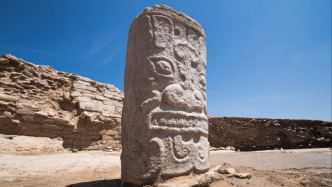
At the junction of the Loess Plateau and the Mu Us Desert, the ancient city of Shimao, built 4,000 years ago, stands silently, telling the story of the formation and development of early Chinese states. Where did the ancestors who created this civilization come from, and what bonds governed this complex society? After 13 years of intensive research, Chinese scientists, through large-scale ancient genome studies, have systematically revealed the mysteries of the origins and social structure of the Shimao culture, an early Chinese civilization. The research findings were published online in *Nature* on November 27th. It is currently the world's largest social genetic analysis of a prehistoric settlement, with unprecedented sample size and analytical depth.
The Shimao site is the largest known prehistoric city site in China. Its complex defensive layout, diverse sacrificial relics, and high-level cultural artifacts demonstrate a typical early state structure and a high degree of social complexity.
A research team led by Fu Qiaomei from the Institute of Vertebrate Paleontology and Paleoanthropology, Chinese Academy of Sciences, in collaboration with the Shaanxi Provincial Institute of Archaeology/Northwest University's Sun Zhouyong team and several other institutions, conducted a large-scale, high-resolution, systematic ancient genome study of the Shimao site. Over 13 years, the research team captured and analyzed 169 ancient human nuclear genomes, providing detailed insights into the genetic origins of the main population of the Shimao culture and the migration and interaction history of prehistoric agricultural and pastoral populations in the Hetao region. This study also marks the first time that ancient DNA has been used to reconstruct the complex social organization structure of China's largest prehistoric city site with clear early state characteristics.
At a press conference held by the State Administration of Cultural Heritage on November 27, Fu Qiaomei introduced that the research had yielded three major discoveries.
First, the study achieved precise tracing of origins, revealing the local roots and diverse integration of the Shimao culture population. It confirms that the main population of the Shimao culture originated from the late Yangshao inhabitants of northern Shaanxi, demonstrating clear genetic continuity and providing empirical evidence at the genetic level of the profound local roots of the Shimao culture. Simultaneously, the study detected genetic components from the Yumin population of the northern grasslands and rice-farming populations of the southern coast in a few individuals, vividly outlining a clear and dynamic picture of the Shimao culture and its related populations, and objectively confirming that Chinese civilization, from its origins, possessed a grand pattern of unity in diversity and inclusiveness.
This study also clarifies the exchange patterns for the first time, identifying the different pathways of population exchange and cultural interaction. The pottery unearthed at the Shimao site is highly similar to the Taosi culture type in southern Shanxi in the Central Plains, while the bronze remains and metallurgical techniques are closely related to those of the Eurasian Steppe. The unearthed crocodile bone plates may have originated from cultures in the Yangtze River basin. So, how did the Shimao culture interact and exchange with ancient populations in surrounding areas during its formation? Fu Qiaomei stated that the research shows that the Shimao population had varying degrees of genetic exchange with agricultural and pastoral populations in the Central Plains of the Yellow River basin, the northern steppes, and the southern coast. It had close exchanges with the Taosi culture and is highly homologous in its genetic structure. However, the main cultural population of Shimao does not show any components related to ancient populations in the western Eurasian steppes, Central Asia, North Asia, or the Shandong coastal region. Elements such as metallurgy are more likely to have been introduced through trade and technological dissemination. “These different evolutionary patterns of genes and culture reflect that Shimao was not only a regional political and military center at that time, but also a highly open cultural and trade hub with cross-regional interaction in prehistoric times,” said Fu Qiaomei.
This study also provides the first insight into social structure, reconstructing the kinship ties and social organization of the early state. The diverse human sacrifice and burial practices found at the Shimao site offer a crucial window into the study of early social organization. This research is the first globally to analyze such a large-scale and highly complex prehistoric capital from a genetic perspective. By analyzing the genetic characteristics of different burial groups and sacrificial victims, it reconstructed a family genealogy spanning four generations among the tomb owners. The study reveals that Shimao society had already formed a stratified society centered on patrilineal lineage. The research team also focused on the burial pits within the ancient city of Shimao. While the "skull pit" at the eastern gate of the outer city did not show a predominantly female human sacrifice pattern, the opposite was true at the Shimao Huangchengtai cemetery and the Hanjiagedan noble cemetery in the inner city, where the sacrificial victims were almost exclusively female. The latter reflects a significant stratification pattern within the Shimao culture. "This transforms Shimao from a grand material relic into a vibrant social entity, providing an unprecedented micro-perspective and model of social organization for understanding the power structure and social organization patterns of early states," said Fu Qiaomei.
This achievement, a collaboration between scientific archaeologists and field archaeologists, is significant beyond simply unraveling the mystery of Shimao. Fu Qiaomei emphasized that it also marks a new stage in related research, moving from studying "objects" to precisely studying people and society, injecting powerful scientific and technological impetus into the study of the origins of Chinese civilization.